Executive Overview: Breaking the Growth Overhead Ceiling
Every growing company eventually runs into the same invisible ceiling: as customer demand expands, overhead costs rise at the exact same pace.
Hiring more administrative staff to copy-paste data between tools, manually triage support inboxes, and chase inbound sales inquiries no longer works. Modern enterprises in high-velocity markets across California, the UK, and the UAE are not winning by out-hiring their competitors. They are winning by automating the friction out of their operational pipelines.
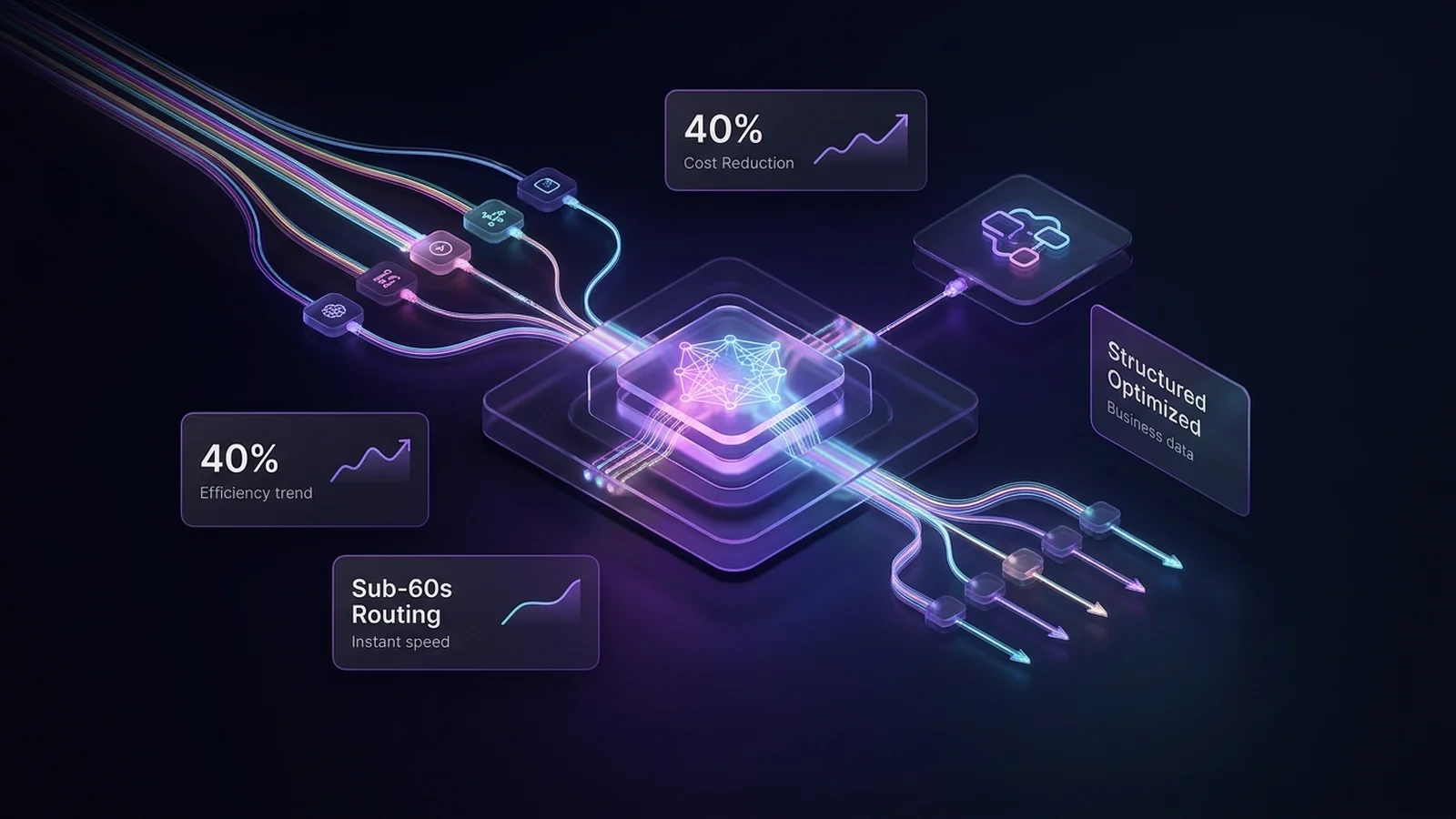
Operational benchmarks from enterprise automation deployments demonstrate that companies deploying production-grade workflow automation consistently reduce routine operating expenses by up to 40% while accelerating process execution speed threefold.
This guide provides an end-to-end operational blueprint on how to automate business processes with artificial intelligence. We examine the core differences between superficial software demos and reliable production systems, identify the four highest-ROI workflows to automate first, and outline how specialized engineering partners build resilient, scalable automation stacks.
1. What Business AI Automation Actually Means in Practice
Before exploring implementation strategies, it is necessary to clear away the buzzwords. A significant amount of marketing noise equates artificial intelligence with novelty chatbots that draft generic social media copy. In a commercial enterprise environment, that definition is completely inadequate.
Real-world AI automation consists of two intertwined layers that work in tandem:
✦The Intelligence Layer
This represents the cognitive processing power of modern Large Language Models and computer vision systems. It handles tasks that previously required human discretion:
- •Enquiry Classification and Routing: Analyzing incoming emails and messages to categorize them by business intent, urgency level, and client matter.
- •Intelligent Document Extraction: Reading, extracting, and standardizing data from unstructured PDF invoices, purchase orders, receipts, and legal contracts without rigid templates.
- •Conversational Prospect Qualification: Evaluating the buying authority, purchasing power, and budget parameters of sales prospects through multi-turn dialogues (AI Lead Qualification).
- •Contextual Knowledge Retrieval: Drafting grounded, accurate responses to complex client support inquiries using verified internal standard operating procedures (AI Knowledge Base).
✦The Digital Services Infrastructure
Artificial intelligence cannot produce tangible business outcomes in isolation. An intelligent model must be anchored by robust digital infrastructure:
- •API Integrations and Webhooks: Clean data connectors linking communication channels like email, SMS, and WhatsApp with centralized CRMs such as Salesforce, HubSpot, and GoHighLevel.
- •Unified Data Stores: Structured relational databases and cloud environments where client records remain continuously synchronized (Data Automation).
- •Operational Validation Rules: Automated error-checking loops and validation scripts that catch missing fields, duplicate entries, or anomalous transactions before data is permanently written.
When these two layers are integrated, a business creates a connected operating system. Routine administrative work happens autonomously behind the scenes, allowing human teams to focus exclusively on client relationships, high-ticket negotiations, and strategic growth.
2. The 4 Highest-ROI Workflows to Automate First
Attempting to automate an entire enterprise simultaneously is a proven recipe for operational paralysis. The most successful organizations follow a targeted approach: they automate the specific bottlenecks where human delays directly cause lost revenue or unnecessary expense.
✦Workflow 1: Instant Inbound Lead Qualification and CRM Routing
In modern B2B sales, speed to contact dictates win rates. Harvard Business School research indicates that contacting an inbound lead within five minutes yields a dramatically higher conversion rate compared to waiting thirty minutes or longer. When leads submit inquiries simultaneously across digital channels, manual delays cause high-intent prospects to drift to competitors.
A production-ready inbound lead funnel operates across five synchronized stages:
- •Multi-Channel Ingestion: The inbound inquiry is captured instantly from website forms, paid ad campaigns, WhatsApp, or third-party marketplaces.
- •Sub-60-Second AI Interaction: An automated conversational agent initiates immediate contact across the prospect's channel of choice, eliminating the cold lag of traditional follow-ups.
- •Conversational Qualification: Rather than presenting an intimidating fifteen-field web form upfront, the AI conducts a natural conversation to verify budget thresholds, project scope, and purchasing timelines.
- •Automated Showing or Demo Scheduling: If the prospect meets pre-defined qualification criteria, the system checks real-time calendar availability and books a discovery meeting or showing directly onto the sales representative's schedule.
- •Enrichment and Real-Time CRM Sync: The conversation transcript, lead score, and structured summary are synchronized directly into the central CRM (CRM Automation), while the assigned sales representative receives an immediate mobile alert.
Unqualified leads or long-term researchers are systematically routed into automated nurture sequences, ensuring sales teams spend their valuable working hours exclusively with pre-screened buyers.
✦Workflow 2: Automated Document Intelligence and Invoice Extraction
Finance, legal, and operational teams routinely lose dozens of hours every week manually transcribing information from PDF attachments, vendor invoices, bills of lading, and signed contracts into accounting software.
Traditional Optical Character Recognition (OCR) systems relied on rigid templates that failed whenever a vendor altered an invoice layout. Modern Vision-Language Models handle document parsing without layout restrictions:
- •Automated Inbox Ingestion: An automated daemon monitors accounts payable inboxes, identifying PDF and scanned image attachments the moment they arrive.
- •Layout-Agnostic Extraction: The AI model parses vendor names, tax identification numbers, line-item descriptions, unit prices, and total balances regardless of document design (Invoice Automation).
- •Three-Way Reconciliation: Automated validation scripts cross-reference extracted totals against purchase orders and database inventory records using mathematical validation:
“
Reconciliation Formula:
Line Item Sum + Applicable Taxes + Shipping = Total Balance Due - •Accounting System Sync: Pre-validated bills are drafted directly inside accounting platforms like QuickBooks, Xero, or SAP for one-click human authorization.
In documented deployments across professional service firms, this automated architecture reduces daily invoice processing time from two hours to under fifteen minutes while maintaining an error rate below 0.1%.
✦Workflow 3: Intelligent Customer Support and Enquiry Triage
Customer service teams are frequently overwhelmed by high-volume, repetitive inquiries regarding pricing, order tracking, appointment scheduling, and basic documentation. This results in response backlogs and frustrated buyers.
A modern AI triage pipeline solves this without creating frustrating, robotic customer experiences:
- •Intent and Urgency Classification: Incoming support tickets and customer emails are categorized in real time based on semantic urgency, account value, and subject matter.
- •Grounded Knowledge Retrieval: The AI agent queries private internal knowledge bases through Retrieval-Augmented Generation (RAG) to draft an accurate, company-approved response (AI Customer Support).
- •Confidence-Score Routing: If the system's confidence score exceeds 95%, routine transactional inquiries are answered instantly. If the question involves complex account disputes or sensitive negotiations, the ticket is routed to a human specialist alongside a pre-drafted response and contextual background notes.
- •Wrong-Routing Reduction: Fine-tuned triage systems consistently reduce misdirected inquiries from industry averages of 15–20% down to under 4%, saving substantial administrative re-routing time.
✦Workflow 4: Cross-System Data Synchronization and Pipeline Hygiene
Most established businesses suffer from disconnected software architecture: sales uses one CRM, operations manages projects in another platform, finance relies on separate billing software, and field teams communicate via mobile messaging apps.
When these systems do not communicate, employees spend their days performing manual copy-paste work. An enterprise workflow automation layer, built using orchestration frameworks like n8n or custom API microservices (Workflow Automation Services), eliminates these data silos:
- •Bidirectional CRM Synchronization: Automatic updates between customer relationship platforms like HubSpot, Salesforce, or GoHighLevel and internal operational databases.
- •Automated Client Onboarding: Instant generation of client onboarding folders, legal contracts, and shared project channels upon closing an opportunity in the sales pipeline.
- •Executive Visibility Dashboards: Real-time automated dashboards that pull metrics from billing, operations, and sales, providing leadership with up-to-the-minute operational clarity without manual spreadsheet updates.
3. Financial Comparison: In-House Development vs. SaaS vs. AI Partner
When operations leaders decide to modernize their workflows, they must choose between three distinct implementation paths. Understanding the true Total Cost of Ownership is critical:
| Decision Factor | Building In-House | Off-the-Shelf SaaS (Zapier / Make / UiPath) | Full-Service AI Partner (ZeroX) |
|---|---|---|---|
| Primary Deliverable | Internal custom codebase | Software tool login / API canvas | Turnkey business outcome & working pipeline |
| Deployment Timeline | 4 to 8 Months | 2 to 6 Months (DIY building) | 2 to 4 Weeks (Production deployment) |
| Internal Resource Drain | High (Requires dedicated developers) | Moderate to High (Ops staff must learn tools) | Minimal (Discovery interview + review calls) |
| Handling Complex Edge Cases | Requires extensive custom coding | High failure rate when schemas change | Resilient architecture with built-in fallbacks |
| Maintenance & Monitoring | Internal team owns 2:00 AM outages | Internal team must diagnose broken zaps | Included in partner SLA retainers |
| First-Year Cost Structure | $150,000+ (Full-time engineer salary) | Licensing fees + internal staff opportunity cost | Fixed project investment with predictable ROI |
✦The Real Cost of "DIY" Platform Building
While an off-the-shelf software subscription appears inexpensive on paper, it hands your organization an empty canvas. Your internal team must design the error logic, write custom transformation scripts, manage API rate limits, and maintain the workflows whenever vendor endpoints update. For businesses without dedicated automation engineers, this creates fragile systems that frequently fail under live operating conditions.
4. The 4-Stage Implementation Framework: How ZeroX Deploys Production Systems
A serious AI automation agency does not pitch speculative technology demos or force-feed rigid software templates. At ZeroX, we execute a battle-tested four-phase deployment methodology designed to deliver tangible operational ROI in under thirty days:
✦Phase 1: Operational Workflow Audit
We conduct a rigorous review of your daily operational pipeline. We analyze where your team spends manual hours, identify error-prone data transfer points, and pinpoint the single highest-ROI process to automate first. If a workflow is not commercially viable for AI automation, we identify that upfront before any capital is committed.
✦Phase 2: Architecture Blueprint and ROI Projection
Before writing a single line of code, our systems architects map the end-to-end data flow:
- •Exact API endpoints, webhook schemas, and database dependencies.
- •LLM model selection, balancing execution speed, reasoning depth, and inference cost.
- •Human-in-the-loop validation checkpoints and automated fallback rules.
- •Transparent project scope, delivery timeline, and projected hours saved.
✦Phase 3: Rapid Engineering and Non-Disruptive Integration (14–30 Days)
Our engineering team builds custom automation pipelines using robust orchestration platforms, such as enterprise n8n, paired with proprietary integration scripts. We connect directly into your existing software tools—Salesforce, Follow Up Boss, QuickBooks, HubSpot, Google Workspace, and WhatsApp—meaning your staff does not have to learn or adopt unfamiliar software.
✦Phase 4: Ongoing Monitoring and 24/7 SLA Support
Automations must survive real-world volume spikes and third-party software updates. ZeroX provides ongoing service-level monitoring, tracking API changes, optimizing prompt reliability, and resolving failure modes so your core business operations never experience downtime.
Frequently Asked Questions
✦Can AI automation connect with our company's existing CRM and software?
Yes. Specialized automation agencies design non-disruptive architectures. By using REST APIs, webhooks, and secure middleware layers, custom AI agents interact directly with your current systems—including Salesforce, HubSpot, GoHighLevel, Follow Up Boss, and ERPs. Your team continues working within their familiar environments while background processes run automatically.
✦What happens if an AI agent encounters an edge case it does not understand?
Production-grade systems are specifically engineered with Human-in-the-Loop (HITL) safeguards. Whenever an AI model encounters ambiguous data, conflicting customer requests, or low confidence scores, the system pauses autonomous execution and routes the task to a human supervisor alongside a structured summary and recommended actions.
✦How quickly does an automation deployment pay for itself?
Most commercial automation workflows generate positive ROI within 60 to 90 days of live deployment. By reclaiming 15 to 25 staff hours per employee each week, eliminating lead leakage, and preventing costly data entry mistakes, organizations routinely recover their initial engineering investment within the first quarter.
✦Is our company's proprietary data secure and compliant?
Enterprise automation frameworks enforce strict enterprise data governance protocols. Systems can be deployed on private virtual clouds or on-premise infrastructure adhering to GDPR, HIPAA, and regional data privacy standards. Sensitive business data is never utilized to train public foundational models.
Conclusion: Scale Operations Without Expanding Payroll
Scaling a modern business does not require doubling your administrative payroll or burying your leadership team under repetitive operational busywork. By replacing manual handoffs with resilient, context-aware AI automations, organizations unlock higher operating margins, faster customer response times, and the capacity to scale effortlessly.
Are repetitive tasks, disconnected tools, or slow lead response times holding your business back from reaching its full potential?
Schedule a Free 30-Minute AI Workflow Audit with the ZeroX Strategy Team or explore our Fixed-Scope Pricing Packages to see how our engineering team eliminates operational bottlenecks in 2 to 4 weeks.